Namal University Jobs August 2026
Namal University Jobs August 2026 :
Organization: Namal University
WE’RE HIRING!
Last Date to Apply Aug 27, 2026
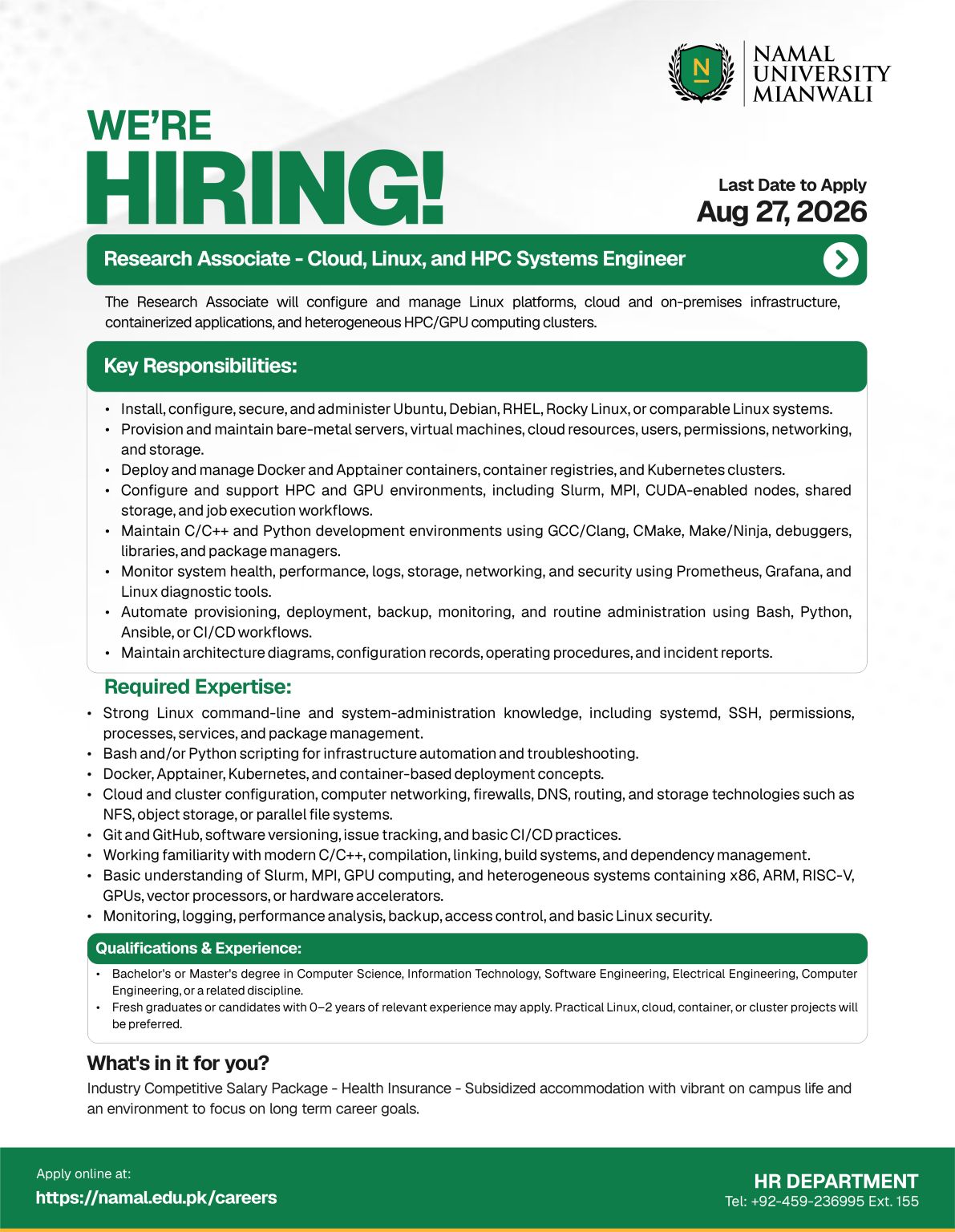
Research Associate – Cloud, Linux, and HPC Systems Engineer
The Research Associate will configure and manage Linux platforms, cloud and on-premises infrastructure, containerized applications, and heterogeneous HPC/GPU computing clusters.
Key Responsibilities:
- Install, configure, secure, and administer Ubuntu, Debian, RHEL, Rocky Linux, or comparable Linux systems.
- Provision and maintain bare-metal servers, virtual machines, cloud resources, users, permissions, networking, and storage.
- Deploy and manage Docker and Apptainer containers, container registries, and Kubernetes clusters.
- Configure and support HPC and GPU environments, including Slurm, MPI, CUDA-enabled nodes, shared storage, and job execution workflows.
- Maintain C/C++ and Python development environments using GCC/Clang, CMake, Make/Ninja, debuggers, libraries, and package managers.
- Monitor system health, performance, logs, storage, networking, and security using Prometheus, Grafana, and Linux diagnostic tools.
- Automate provisioning, deployment, backup, monitoring, and routine administration using Bash, Python, Ansible, or CI/CD workflows.
- Maintain architecture diagrams, configuration records, operating procedures, and incident reports.
Required Expertise:
- Strong Linux command-line and system-administration knowledge, including systemd, SSH, permissions, processes, services, and package management.
- Bash and/or Python scripting for infrastructure automation and troubleshooting.
- Docker, Apptainer, Kubernetes, and container-based deployment concepts.
- Cloud and cluster configuration, computer networking, firewalls, DNS, routing, and storage technologies such as NFS, object storage, or parallel file systems.
- Git and GitHub, software versioning, issue tracking, and basic CI/CD practices.
- Working familiarity with modern C/C++, compilation, linking, build systems, and dependency management.
- Basic understanding of Slurm, MPI, GPU computing, and heterogeneous systems containing x86, ARM, RISC-V, GPUs, vector processors, or hardware accelerators.
- Monitoring, logging, performance analysis, backup, access control, and basic Linux security.
Qualifications & Experience:
- Bachelor’s or Master’s degree in Computer Science, Information Technology, Software Engineering, Electrical Engineering, Computer Engineering, or a related discipline.
- Fresh graduates or candidates with 0-2 years of relevant experience may apply. Practical Linux, cloud, container, or cluster projects will be preferred.
What’s in it for you? Industry Competitive Salary Package – Health Insurance – Subsidized accommodation with vibrant on campus life and an environment to focus on long term career goals.
Apply online at: https://namal.edu.pk/careers
HR DEPARTMENT Tel: +92-459-236995 Ext. 155
WE’RE HIRING!
Last Date to Apply: Aug 27, 2026
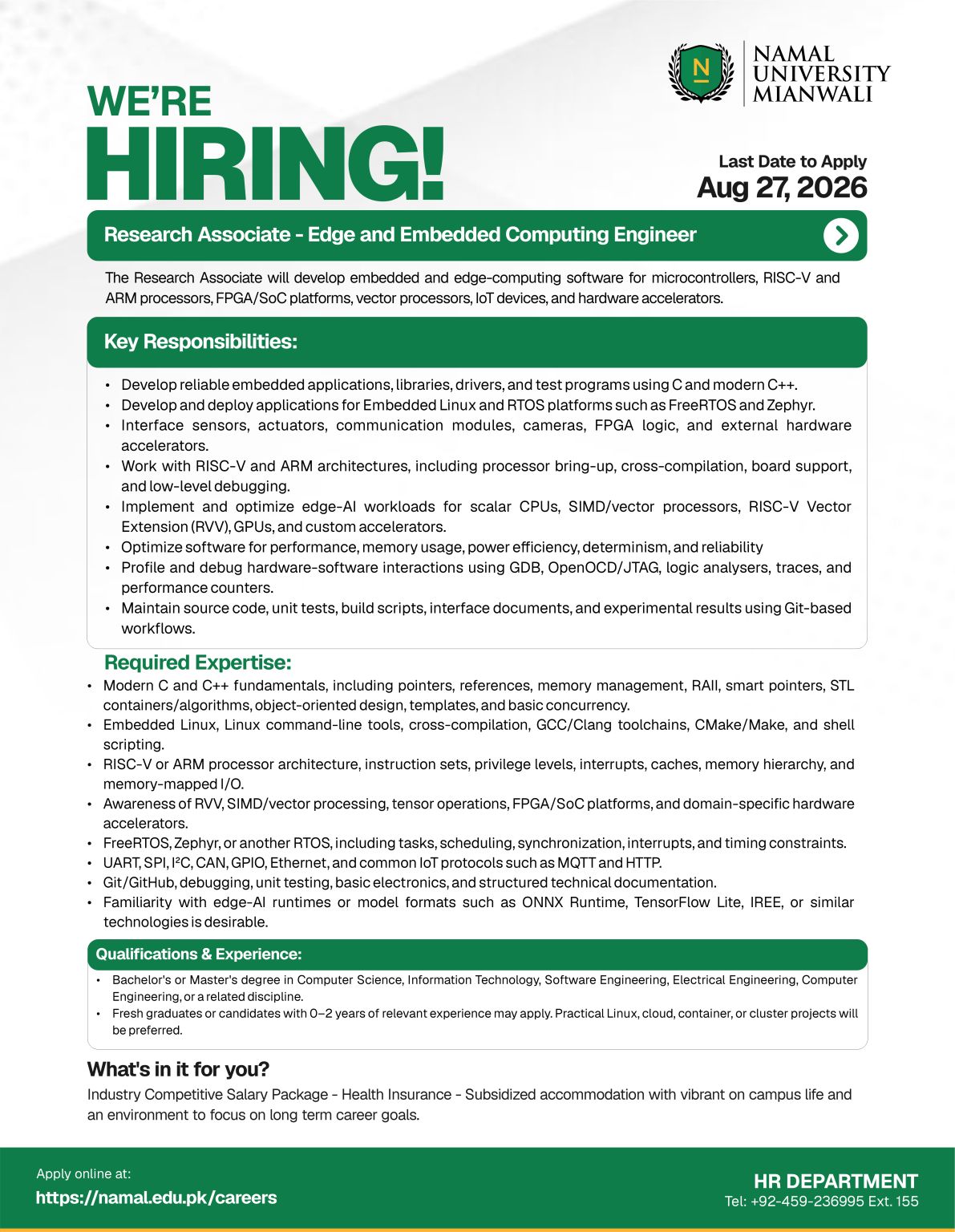
Research Associate – Edge and Embedded Computing Engineer
The Research Associate will develop embedded and edge-computing software for microcontrollers, RISC-V and ARM processors, FPGA/SoC platforms, vector processors, IoT devices, and hardware accelerators.
Key Responsibilities:
- Develop reliable embedded applications, libraries, drivers, and test programs using C and modern C++.
- Develop and deploy applications for Embedded Linux and RTOS platforms such as FreeRTOS and Zephyr.
- Interface sensors, actuators, communication modules, cameras, FPGA logic, and external hardware accelerators.
- Work with RISC-V and ARM architectures, including processor bring-up, cross-compilation, board support, and low-level debugging.
- Implement and optimize edge-AI workloads for scalar CPUs, SIMD/vector processors, RISC-V Vector Extension (RVV), GPUs, and custom accelerators.
- Optimize software for performance, memory usage, power efficiency, determinism, and reliability.
- Profile and debug hardware-software interactions using GDB, OpenOCD/JTAG, logic analysers, traces, and performance counters.
- Maintain source code, unit tests, build scripts, interface documents, and experimental results using Git-based workflows.
Required Expertise:
- Modern C and C++ fundamentals, including pointers, references, memory management, RAII, smart pointers, STL containers/algorithms, object-oriented design, templates, and basic concurrency.
- Embedded Linux, Linux command-line tools, cross-compilation, GCC/Clang toolchains, CMake/Make, and shell scripting.
- RISC-V or ARM processor architecture, instruction sets, privilege levels, interrupts, caches, memory hierarchy, and memory-mapped I/O.
- Awareness of RVV, SIMD/vector processing, tensor operations, FPGA/SoC platforms, and domain-specific hardware accelerators.
- FreeRTOS, Zephyr, or another RTOS, including tasks, scheduling, synchronization, interrupts, and timing constraints.
- UART, SPI, I²C, CAN, GPIO, Ethernet, and common IoT protocols such as MQTT and HTTP.
- Git/GitHub, debugging, unit testing, basic electronics, and structured technical documentation.
- Familiarity with edge-AI runtimes or model formats such as ONNX Runtime, TensorFlow Lite, IREE, or similar technologies is desirable.
Qualifications & Experience:
- Bachelor’s or Master’s degree in Computer Science, Information Technology, Software Engineering, Electrical Engineering, Computer Engineering, or a related discipline.
- Fresh graduates or candidates with 0–2 years of relevant experience may apply. Practical Linux, cloud, container, or cluster projects will be preferred.
What’s in it for you?
- Industry Competitive Salary Package – Health Insurance – Subsidized accommodation with vibrant on campus life and an environment to focus on long term career goals.
Apply online at: https://namal.edu.pk/careers
HR DEPARTMENT
Tel: +92-459-236995 Ext. 155
WE’RE HIRING!
Last Date to Apply: Aug 27, 2026
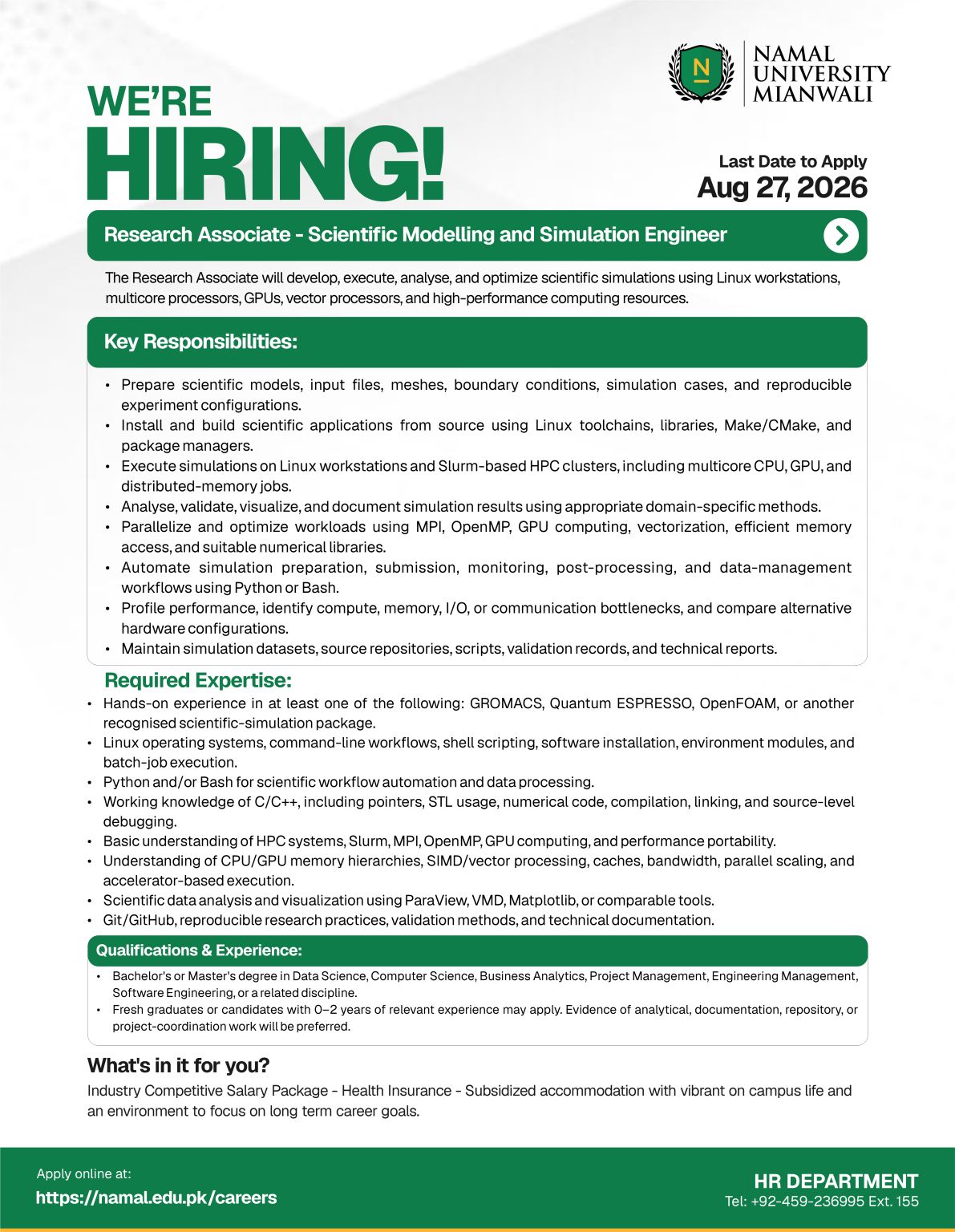
Position: Research Associate – Scientific Modelling and Simulation Engineer
Overview The Research Associate will develop, execute, analyse, and optimize scientific simulations using Linux workstations, multicore processors, GPUs, vector processors, and high-performance computing resources.
Key Responsibilities:
- Prepare scientific models, input files, meshes, boundary conditions, simulation cases, and reproducible experiment configurations.
- Install and build scientific applications from source using Linux toolchains, libraries, Make/CMake, and package managers.
- Execute simulations on Linux workstations and Slurm-based HPC clusters, including multicore CPU, GPU, and distributed-memory jobs.
- Analyse, validate, visualize, and document simulation results using appropriate domain-specific methods.
- Parallelize and optimize workloads using MPI, OpenMP, GPU computing, vectorization, efficient memory access, and suitable numerical libraries.
- Automate simulation preparation, submission, monitoring, post-processing, and data-management workflows using Python or Bash.
- Profile performance, identify compute, memory, I/O, or communication bottlenecks, and compare alternative hardware configurations.
- Maintain simulation datasets, source repositories, scripts, validation records, and technical reports.
Required Expertise:
- Hands-on experience in at least one of the following: GROMACS, Quantum ESPRESSO, OpenFOAM, or another recognised scientific-simulation package.
- Linux operating systems, command-line workflows, shell scripting, software installation, environment modules, and batch-job execution.
- Python and/or Bash for scientific workflow automation and data processing.
- Working knowledge of C/C++, including pointers, STL usage, numerical code, compilation, linking, and source-level debugging.
- Basic understanding of HPC systems, Slurm, MPI, OpenMP, GPU computing, and performance portability.
- Understanding of CPU/GPU memory hierarchies, SIMD/vector processing, caches, bandwidth, parallel scaling, and accelerator-based execution.
- Scientific data analysis and visualization using ParaView, VMD, Matplotlib, or comparable tools.
- Git/GitHub, reproducible research practices, validation methods, and technical documentation.
Qualifications & Experience:
- Bachelor’s or Master’s degree in Data Science, Computer Science, Business Analytics, Project Management, Engineering Management, Software Engineering, or a related discipline.
- Fresh graduates or candidates with 0–2 years of relevant experience may apply. Evidence of analytical, documentation, repository, or project-coordination work will be preferred.
What’s in it for you? Industry Competitive Salary Package – Health Insurance – Subsidized accommodation with vibrant on campus life and an environment to focus on long term career goals.
Application Details:
- Apply online at: https://namal.edu.pk/careers
- HR DEPARTMENT: Tel: +92-459-236995 Ext. 155
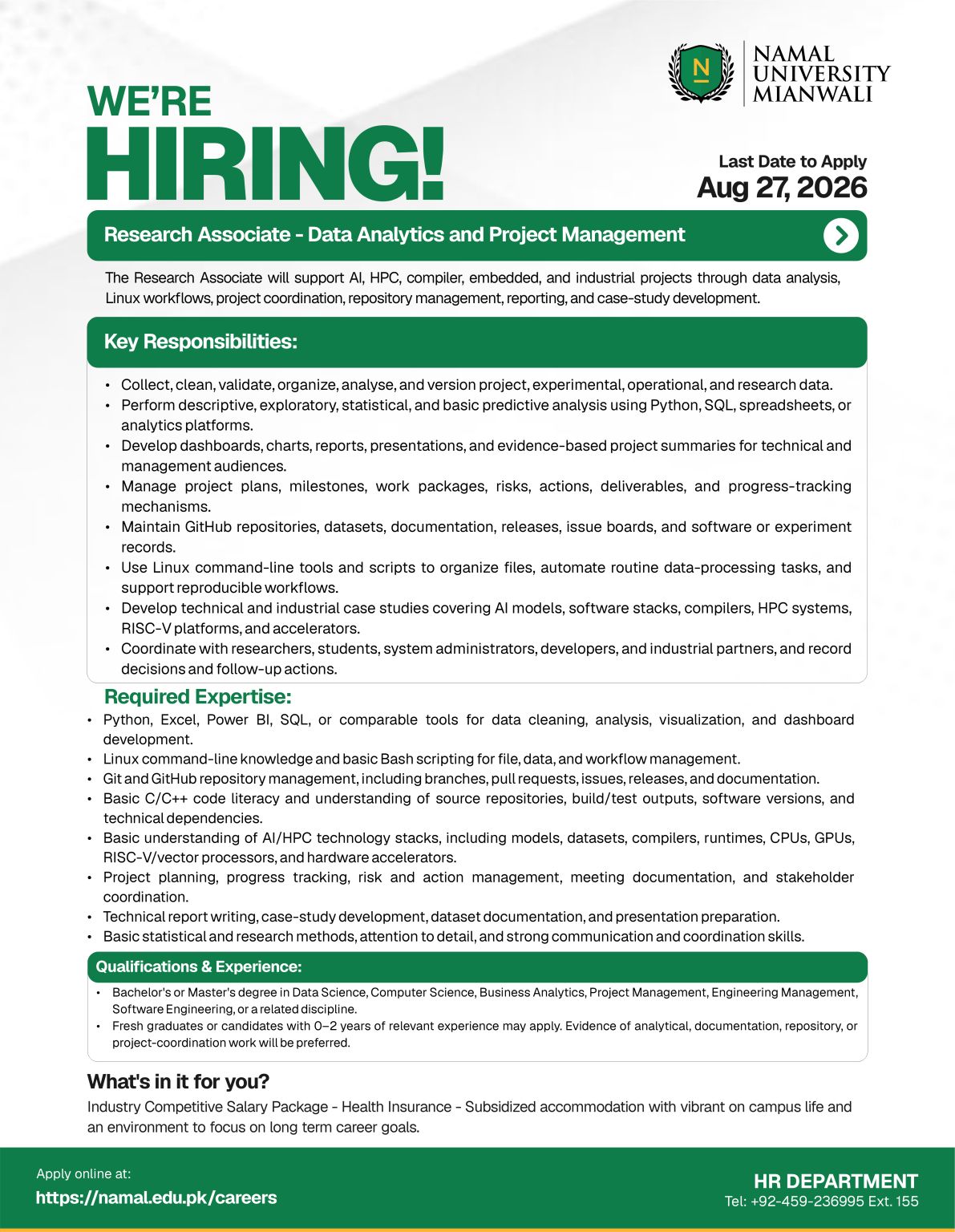
WE’RE HIRING!
Last Date to Apply: Aug 27, 2026
Research Associate – Data Analytics and Project Management
The Research Associate will support AI, HPC, compiler, embedded, and industrial projects through data analysis, Linux workflows, project coordination, repository management, reporting, and case-study development.
Key Responsibilities:
- Collect, clean, validate, organize, analyse, and version project, experimental, operational, and research data.
- Perform descriptive, exploratory, statistical, and basic predictive analysis using Python, SQL, spreadsheets, or analytics platforms.
- Develop dashboards, charts, reports, presentations, and evidence-based project summaries for technical and management audiences.
- Manage project plans, milestones, work packages, risks, actions, deliverables, and progress-tracking mechanisms.
- Maintain GitHub repositories, datasets, documentation, releases, issue boards, and software or experiment records.
- Use Linux command-line tools and scripts to organize files, automate routine data-processing tasks, and support reproducible workflows.
- Develop technical and industrial case studies covering AI models, software stacks, compilers, HPC systems, RISC-V platforms, and accelerators.
- Coordinate with researchers, students, system administrators, developers, and industrial partners, and record decisions and follow-up actions.
Required Expertise:
- Python, Excel, Power BI, SQL, or comparable tools for data cleaning, analysis, visualization, and dashboard development.
- Linux command-line knowledge and basic Bash scripting for file, data, and workflow management.
- Git and GitHub repository management, including branches, pull requests, issues, releases, and documentation.
- Basic C/C++ code literacy and understanding of source repositories, build/test outputs, software versions, and technical dependencies.
- Basic understanding of AI/HPC technology stacks, including models, datasets, compilers, runtimes, CPUs, GPUs, RISC-V/vector processors, and hardware accelerators.
- Project planning, progress tracking, risk and action management, meeting documentation, and stakeholder coordination.
- Technical report writing, case-study development, dataset documentation, and presentation preparation.
- Basic statistical and research methods, attention to detail, and strong communication and coordination skills.
Qualifications & Experience:
- Bachelor’s or Master’s degree in Data Science, Computer Science, Business Analytics, Project Management, Engineering Management, Software Engineering, or a related discipline.
- Fresh graduates or candidates with 0–2 years of relevant experience may apply. Evidence of analytical, documentation, repository, or project-coordination work will be preferred.
What’s in it for you? Industry Competitive Salary Package – Health Insurance – Subsidized accommodation with vibrant on campus life and an environment to focus on long term career goals.
Apply online at: https://namal.edu.pk/careers
HR DEPARTMENT Tel: +92-459-236995 Ext. 155
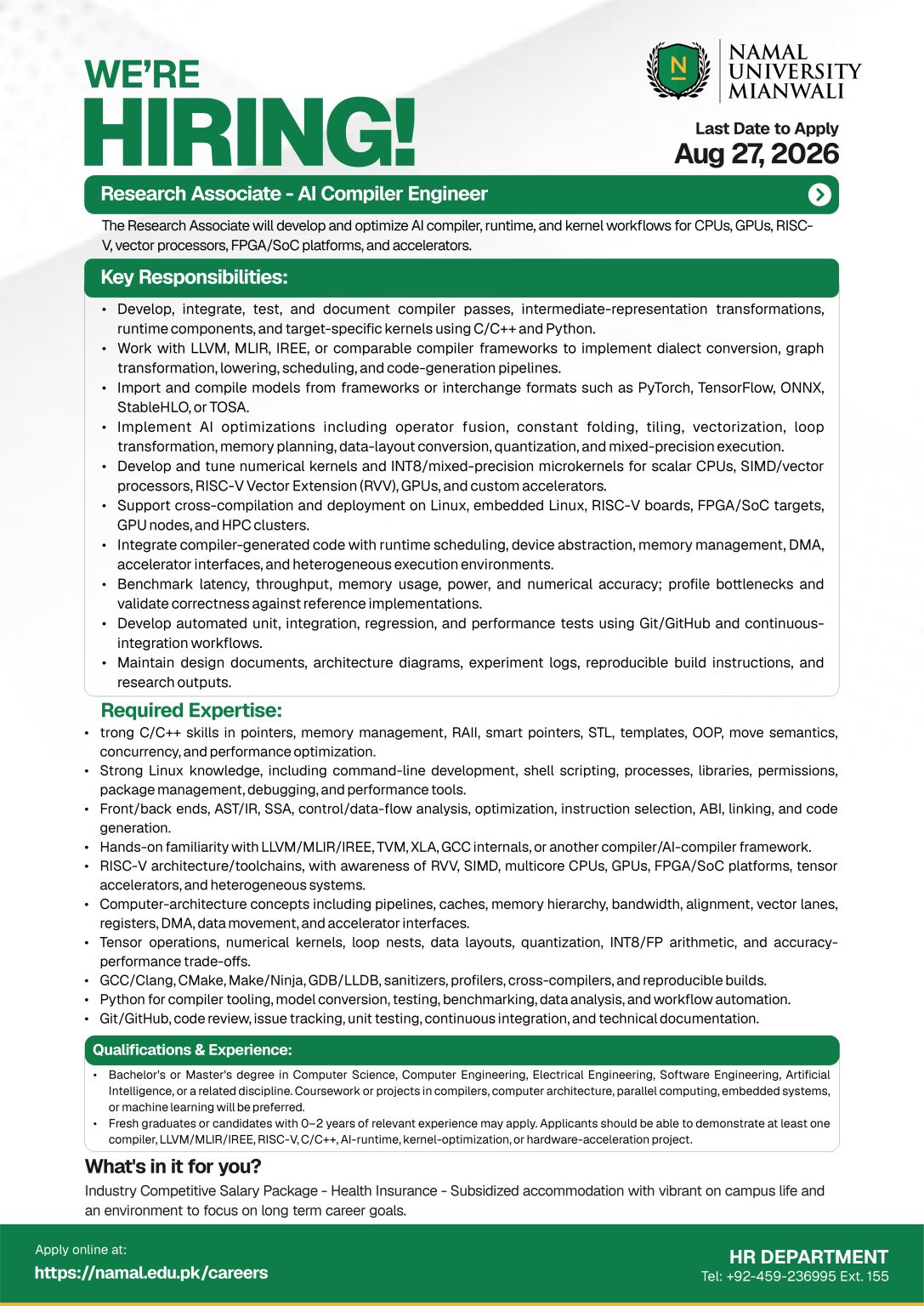
WE’RE HIRING!
Last Date to Apply: Aug 27, 2026
Research Associate – AI Compiler Engineer
The Research Associate will develop and optimize AI compiler, runtime, and kernel workflows for CPUs, GPUs, RISC-V, vector processors, FPGA/SoC platforms, and accelerators.
Key Responsibilities:
- Develop, integrate, test, and document compiler passes, intermediate-representation transformations, runtime components, and target-specific kernels using C/C++ and Python.
- Work with LLVM, MLIR, IREE, or comparable compiler frameworks to implement dialect conversion, graph transformation, lowering, scheduling, and code-generation pipelines.
- Import and compile models from frameworks or interchange formats such as PyTorch, TensorFlow, ONNX, StableHLO, or TOSA.
- Implement AI optimizations including operator fusion, constant folding, tiling, vectorization, loop transformation, memory planning, data-layout conversion, quantization, and mixed-precision execution.
- Develop and tune numerical kernels and INT8/mixed-precision microkernels for scalar CPUs, SIMD/vector processors, RISC-V Vector Extension (RVV), GPUs, and custom accelerators.
- Support cross-compilation and deployment on Linux, embedded Linux, RISC-V boards, FPGA/SoC targets, GPU nodes, and HPC clusters.
- Integrate compiler-generated code with runtime scheduling, device abstraction, memory management, DMA, accelerator interfaces, and heterogeneous execution environments.
- Benchmark latency, throughput, memory usage, power, and numerical accuracy; profile bottlenecks and validate correctness against reference implementations.
- Develop automated unit, integration, regression, and performance tests using Git/GitHub and continuous-integration workflows.
- Maintain design documents, architecture diagrams, experiment logs, reproducible build instructions, and research outputs.
Required Expertise:
- Strong C/C++ skills in pointers, memory management, RAII, smart pointers, STL, templates, OOP, move semantics, concurrency, and performance optimization.
- Strong Linux knowledge, including command-line development, shell scripting, processes, libraries, permissions, package management, debugging, and performance tools.
- Front/back ends, AST/IR, SSA, control/data-flow analysis, optimization, instruction selection, ABI, linking, and code generation.
- Hands-on familiarity with LLVM/MLIR/IREE, TVM, XLA, GCC internals, or another compiler/AI-compiler framework.
- RISC-V architecture/toolchains, with awareness of RVV, SIMD, multicore CPUs, GPUs, FPGA/SoC platforms, tensor accelerators, and heterogeneous systems.
- Computer-architecture concepts including pipelines, caches, memory hierarchy, bandwidth, alignment, vector lanes, registers, DMA, data movement, and accelerator interfaces.
- Tensor operations, numerical kernels, loop nests, data layouts, quantization, INT8/FP arithmetic, and accuracy-performance trade-offs.
- GCC/Clang, CMake, Make/Ninja, GDB/LLDB, sanitizers, profilers, cross-compilers, and reproducible builds.
- Python for compiler tooling, model conversion, testing, benchmarking, data analysis, and workflow automation.
- Git/GitHub, code review, issue tracking, unit testing, continuous integration, and technical documentation.
Qualifications & Experience:
- Bachelor’s or Master’s degree in Computer Science, Computer Engineering, Electrical Engineering, Software Engineering, Artificial Intelligence, or a related discipline. Coursework or projects in compilers, computer architecture, parallel computing, embedded systems, or machine learning will be preferred.
- Fresh graduates or candidates with 0–2 years of relevant experience may apply. Applicants should be able to demonstrate at least one compiler, LLVM/MLIR/IREE, RISC-V, C/C++, AI-runtime, kernel-optimization, or hardware-acceleration project.
What’s in it for you?
Industry Competitive Salary Package – Health Insurance – Subsidized accommodation with vibrant on campus life and an environment to focus on long term career goals.
Apply online at: https://namal.edu.pk/careers
HR DEPARTMENT
Tel: +92-459-236995 Ext. 155